3. Is it right?
A function that looks right on five messages can be wrong on one in five. By the end you will measure team on eighty messages with a number you can defend: how often it's right, how sure you can be, compared with what, and where it goes wrong.
Can you skip this one? If you can answer these, jump to tutorial 4. The answers are at the bottom.
- A function is right on 72 of 80 rows. Between which two numbers is its true accuracy, probably?
- Why is 90% accuracy not impressive when 90% of your rows are one class?
- You run the same evaluation twice and get two different scores. Is something broken?
You will: evaluate a function with a 95% interval, see how the interval shrinks with rows, measure baselines (plain Julia functions), read a confusion table, and measure run-to-run variation.
Setting up
using FunctAI, DataFrames, CairoMakie, Statistics

log_folder = mktempdir()
FunctAI.configure!(lm = "gpt-6-luna", log_calls = log_folder)

tickets = DataFrame(FunctAI.tickets())

@enum Team shipping billing product account

@ai function team(message::String)::Team
    "Which team should answer this customer message?"
end;
This is tutorial 1's team, without the house rules, so it has something left to get wrong.
A score and its interval
evaluate runs a function on every row, compares each answer with the right one, and summarises:
ev = evaluate(team, tickets; expected = :category)Evaluation of team on 80 rows
exact_match 0.95 (95% range 0.88 to 0.98)
every row: DataFrame(e)expected = :category says which column holds the right answers. (Without it, evaluate looks for a column named like the function's answer, result; the answer key here is called category.) The inputs are found the same way: the column message goes to the input message. A Team answer is compared with the text in category by its name, ignoring case and extra spaces, so billing matches "billing".
The first number is the share it got right. The two after it are a 95% interval: if you drew many more messages like these, the function's true accuracy would very likely lie between them. Read the interval before the score. It's the honest summary of what eighty rows can tell you.
There's nothing mysterious about it. Being right or wrong is a yes/no outcome, so the score is a proportion, and this is Wilson's interval for a proportion, the one HypothesisTests.jl gives:
using HypothesisTests

right = round(Int, ev.score * length(ev))
confint(BinomialTest(right, length(ev)); method = :wilson)
(0.8783772379535697, 0.9803864454644557)The numbers are the ones evaluate printed. ev.score, ev.low and ev.high hold them, and an evaluation is a table (a Tables.jl source), one row per row you gave it: its columns, the answer (pred_result), its score, and the id of its call:
rows = DataFrame(ev)
select(rows, :category, :pred_result, :exact_match, :call)
80×4 DataFrame
Row │ category pred_result exact_match call
│ String Team Float64 String
─────┼───────────────────────────────────────────────────────────────────────
1 │ shipping shipping 1.0 01a0e4db-e831-7eaa-a57c-e637e129…
2 │ shipping shipping 1.0 01a0e4dc-3167-7c98-b2d2-3014351b…
3 │ billing billing 1.0 01a0e4dc-3168-79fe-b845-4d47cc36…
4 │ account account 1.0 01a0e4dc-3168-7693-b6e3-840540c8…
5 │ product product 1.0 01a0e4dc-3169-79b3-9d8b-7720bf06…
6 │ billing billing 1.0 01a0e4dc-3169-7cc2-8bf1-2209fc51…
7 │ shipping shipping 1.0 01a0e4dc-3169-7015-be01-3ec0318f…
8 │ account account 1.0 01a0e4dc-316a-756a-91ff-908444b1…
⋮ │ ⋮ ⋮ ⋮ ⋮
74 │ billing billing 1.0 01a0e4dc-6616-74d1-aff7-3b9f82b4…
75 │ product product 1.0 01a0e4dc-6636-7d31-947c-1e3321d2…
76 │ account account 1.0 01a0e4dc-675a-70fa-9a74-a590bd7b…
77 │ shipping shipping 1.0 01a0e4dc-688a-717f-96c6-47ef6af4…
78 │ billing billing 1.0 01a0e4dc-68a9-7de5-b520-33aae74b…
79 │ product product 1.0 01a0e4dc-6945-74a6-91e7-8cdafe79…
80 │ account account 1.0 01a0e4dc-69e8-726f-92de-15687e1a…
65 rows omittedHow many rows do you need?
The interval narrows as you add rows, by the square root of their number. You don't need a model to see it: score_interval computes it for any scores. For a function that is right 85% of the time:
widths = map([20, 50, 80, 200, 500, 2000]) do n
    k = round(Int, 0.85n)
    (; rows = n, score_interval(vcat(ones(k), zeros(n - k)))...)
end
DataFrame(widths)
6×4 DataFrame
Row │ rows mean low high
│ Int64 Float64 Float64 Float64
─────┼────────────────────────────────────
1 │ 20 0.85 0.639581 0.947631
2 │ 50 0.84 0.714858 0.916626
3 │ 80 0.85 0.755868 0.91206
4 │ 200 0.85 0.793944 0.892864
5 │ 500 0.85 0.816039 0.878624
6 │ 2000 0.85 0.833681 0.864977With twenty rows, "85%" means anything from about 64% to 95%. With two hundred, you can tell 85% from 80%. Fifty to two hundred carefully labelled rows is usually the sweet spot: an afternoon of work that tells you whether to trust the next hundred thousand.
Compared with what?
A score means nothing on its own. Is 90% good? It depends on how well something much simpler would do. Always measure a baseline.
The simplest is the "null model": always answer the most common team.
sort(combine(groupby(tickets, :category), nrow => :n), :n, rev = true)4×2 DataFrame
Row │ category n
│ String Int64
─────┼─────────────────
1 │ shipping 22
2 │ billing 22
3 │ account 18
4 │ product 18Then something a person might write in ten minutes: a keyword rule. It's an ordinary Julia function, and it returns a Team too:
function keyword_rule(message::AbstractString)::Team
    m = lowercase(message)
    occursin(r"charge|refund|invoice|coupon|card|pay|money", m)     && return billing
    occursin(r"password|sign in|log in|login|account|email|data", m) && return account
    occursin(r"arriv|deliver|track|parcel|package|box|order", m)     && return shipping
    return product
end

keyword_rule("Where is my parcel?")
shipping::Team = 0evaluate takes any function, not only AI functions: a plain one is called with each row, as a NamedTuple. So the baselines are measured exactly like team:
always_shipping(row) = shipping
keywords(row) = keyword_rule(row.message)

scores = DataFrame(model = ["always shipping", "keyword rule", "team (gpt-6-luna)"],
                   ev = [evaluate(always_shipping, tickets; expected = :category),
                         evaluate(keywords, tickets; expected = :category),
                         ev])
scores = select(scores, :model, :ev => ByRow(e -> (accuracy = e.score, low = e.low, high = e.high)) => AsTable)
3×4 DataFrame
Row │ model accuracy low high
│ String Float64 Float64 Float64
─────┼─────────────────────────────────────────────────
1 │ always shipping 0.275 0.189178 0.381441
2 │ keyword rule 0.9375 0.861899 0.973011
3 │ team (gpt-6-luna) 0.95 0.878377 0.980386fig = Figure(size = (700, 200))
ax = Axis(fig[1, 1], xlabel = "accuracy, with its 95% interval", yticks = (1:3, scores.model), limits = ((0, 1), nothing))
rangebars!(ax, 1:3, scores.low, scores.high; direction = :x, whiskerwidth = 8)
scatter!(ax, scores.accuracy, 1:3; markersize = 10)
fig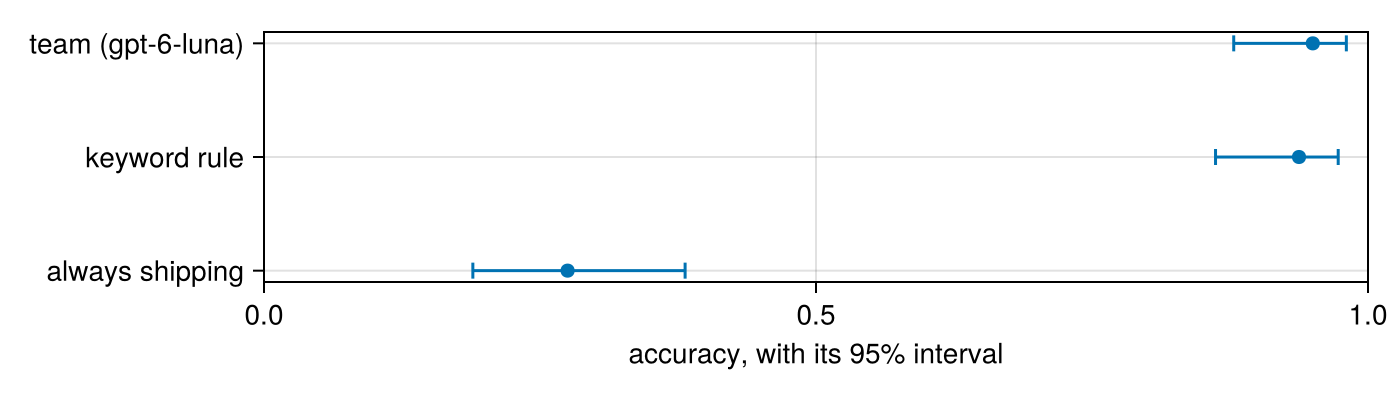
The null model gets about one in four, by construction: four teams of roughly equal size. The keyword rule is the humbling one. Its interval overlaps the language model's, so on these eighty messages you may not be able to tell them apart.
Two things keep that in proportion. First, the rule was written by someone who had read these very messages, so it has been fitted to them: next month's messages will use words it has never seen. Second, the language model got there with one sentence and no knowledge of the shop. But the lesson stands, and it's the reason to always measure a baseline: sometimes the simple thing is nearly as good, and much cheaper.
Where does it go wrong?
A single accuracy hides which mistakes it makes. A confusion table shows them: one row per true team, one column per answer.
pairs = combine(groupby(rows, [:category, :pred_result]), nrow => :n)
unstack(transform(pairs, :pred_result => ByRow(string) => :answer), :category, :answer, :n, fill = 0)
4×5 DataFrame
Row │ category shipping billing account product
│ String Int64 Int64 Int64 Int64
─────┼───────────────────────────────────────────────
1 │ shipping 22 0 0 0
2 │ billing 1 18 0 3
3 │ account 0 0 18 0
4 │ product 0 0 0 18The cells where the row and the column name the same team are where it was right. Everything else is a kind of mistake, and in most jobs they're far from spread evenly. Two questions, per team, make it precise:
- Recall: of the messages that really were billing, what share did it send to billing?
- Precision: of the messages it sent to billing, what share really were billing?
recall = combine(groupby(rows, :category), :exact_match => mean => :recall)
precision = combine(groupby(transform(rows, :pred_result => ByRow(string) => :category), :category),
                    :exact_match => mean => :precision)
leftjoin(recall, precision, on = :category)
4×3 DataFrame
Row │ category recall precision
│ String Float64 Float64?
─────┼───────────────────────────────
1 │ shipping 1.0 0.956522
2 │ billing 0.818182 1.0
3 │ account 1.0 1.0
4 │ product 1.0 0.857143Which one matters depends on what a mistake costs. If billing messages sent elsewhere are lost for days, you care about billing's recall. If the billing team is small and drowning, you care about its precision. That question, what each mistake costs, is the whole of tutorial 6.
Same question, another answer
Run the same evaluation again:
ev2 = evaluate(team, tickets; expected = :category)Evaluation of team on 80 rows
exact_match 0.97 (95% range 0.91 to 0.99)
every row: DataFrame(e)The score may move, and some rows may flip. That's not a bug. A language model picks each word from a distribution, and recent models like gpt-6-luna also think before answering, differently each time. How often do the two runs agree, row by row?
runs = DataFrame(category = tickets.category, first_run = DataFrame(ev).pred_result,
                 second_run = DataFrame(ev2).pred_result, message = tickets.message)
mean(runs.first_run .== runs.second_run)0.975filter(r -> r.first_run != r.second_run, runs)2×4 DataFrame
Row │ category first_run second_run message
│ String Team Team String
─────┼────────────────────────────────────────────────────────────────────
1 │ billing product billing Money back please, the knife set…
2 │ billing product billing Refund please: the towels are mu…On a run like this one the two may agree on every row, or differ on a few: run it a few times and you'll see both. The rows that do flip are the ones the model finds hard, usually the same ones a person would hesitate over. Older models let you turn randomness down with temperature = 0. Current reasoning models don't take it:
configure(team; temperature = 0)("Where is my parcel?")[ Warning: openai:gpt-6-luna does not take temperature; left out of its requests
shipping::Team = 0FunctAI leaves the setting out and tells you once, rather than failing every row. So the honest way to handle the variation is the one you already have: report intervals, and don't read much into a point or two.
What it cost
prices = DataFrame(model = ["gpt-6-luna"], input = [0.10], output = [0.50])   # dollars per million tokens, 2026-09-27

bill = leftjoin(DataFrame(calls(folder = log_folder)), prices, on = :model)
(calls = nrow(bill),
 dollars = sum(bill.input_tokens .* bill.input .+ (bill.total_tokens .- bill.input_tokens) .* bill.output) / 1e6)
(calls = 161, dollars = 0.003968699999999999)Your turn
- Evaluate tutorial 1's
team_rules(with the house rules) ontickets. Does its interval overlapteam's? What does that tell you, and what doesn't it? (Tutorial 4 has a sharper test for two functions run on the same rows.) - The keyword rule has no model at all. Improve it by one line (the confusion table is a good guide) and measure it again. Can a rule of ten lines reach the language model's interval?
- Which team has the lowest recall? Read three of its missed messages. Is the model wrong, or is the label arguable?
What you learned
evaluate(f, data; expected = :column)scores a function on rows with known answers: a proportion with a 95% interval (Wilson's, as HypothesisTests.jl computes it). The evaluation is a table:DataFrame(ev).- Read the interval first. Its width depends on the number of rows: fifty to two hundred rows is usually enough to decide.
- Always compare with a baseline, the most common answer and a simple rule, measured by the same
evaluate: it takes any Julia function. - A confusion table shows which mistakes; recall and precision per class say which ones matter.
- The same function can answer differently twice. Measure how often, and let intervals absorb it.
Answers to the check at the top. (1) About 81% to 95%: score_interval(vcat(ones(72), zeros(8))). (2) Because always answering that class scores 90%; compare with the null model. (3) No: language models vary from run to run, reasoning models more so; compare runs row by row and report intervals.
Next: 4. Making it better without fooling yourself tries rules, examples and a teacher, and tests each change fairly.