1. Your first AI function
Eighty customer messages, four teams, and a function whose body is a language model. By the end you will have sorted every message, counted how many it got right, made it better, and know what it cost to the cent.
A small homeware shop gets messages all day: a parcel that never came, a card charged twice, a kettle that won't boil, a password that won't work. Someone reads each one and forwards it to the team that can help: shipping, billing, product or account. Reading eighty messages is a morning. Reading eighty thousand is a job nobody wants.
You are going to write the function that does the reading, and use it like any other R function. This is where we are going:
tickets |>
  mutate(team = team(message)) |>
  count(team)
A column of text goes in; a column of teams comes out, as a factor, one model call per row. Everything else in this tutorial is about trusting that column.
What you need
- R 4.1 or later, and the packages below. functai, and the two packages it uses to talk to models (lmcc and lm15), install from GitHub:
install.packages(c("remotes", "dplyr", "ggplot2"))
remotes::install_github("MaximeRivest/lmcc", subdir = "r")
remotes::install_github("lm15-dev/lm15-r")
remotes::install_github("MaximeRivest/functai", subdir = "r")
- A key for a model provider. This series mostly uses OpenAI's. Put it in your
~/.Renvironfile (usethis::edit_r_environ()opens it), then restart R:
OPENAI_API_KEY=sk-...
- Less than a cent of model calls. You will see the exact bill at the end.
Setting up
library(functai)
library(dplyr)
library(ggplot2)

log_folder <- tempfile("functai-calls-")
ai_config(lm = "gpt-6-luna", log_calls = log_folder)
ai_config() sets choices for the whole session:
lmis the language model that will do the work.gpt-6-lunais OpenAI's smallest current model (September 2026): fast, and cheap enough that a thousand messages cost a few cents.log_callskeeps a record of every call in a folder. We will read it at the end to count what we spent. (tempfile()makes a fresh, empty folder name, so this tutorial only counts its own calls.)
The messages
functai comes with the shop's messages as a dataset, tickets. A person has already decided which team should answer each one: that's the category column. We won't show it to the model; it's the answer key.
tickets
# A tibble: 80 × 5
      id message                                       channel category order_id
   <int> <chr>                                         <chr>   <chr>    <chr>
 1     1 Hi, my order A-1042 still hasn't arrived and… email   shipping A-1042
 2     2 The mug arrived in pieces.                    chat    shipping <NA>
 3     3 I was charged twice for order B-2210, please… email   billing  B-2210
 4     4 How do I change the email on my account?      chat    account  <NA>
 5     5 The kettle lid doesn't close properly anymor… email   product  <NA>
 6     6 I'd like my money back for the toaster, it b… email   billing  <NA>
 7     7 Tracking for C-3319 hasn't moved since Monda… chat    shipping C-3319
 8     8 I forgot my password and the reset email nev… chat    account  <NA>
 9     9 Box was crushed and the lamp inside is crack… email   shipping D-4001
10    10 My coupon code SPRING10 didn't apply at chec… chat    billing  <NA>
# ℹ 70 more rows
count(tickets, category)
# A tibble: 4 × 2
  category     n
  <chr>    <int>
1 account     18
2 billing     22
3 product     18
4 shipping    22
A function with no body
Here is the function:
team <- ai(team ~ message, "Which team should answer this customer message?",
  team = choice("shipping", "billing", "product", "account"))
Read it the way you read a model formula:
team ~ messageis team, from the message, aslm(weight ~ height)is weight from height. What comes out goes on the left, what goes in on the right. The function is named after what it gives,team, and takes one argument,message.- The sentence says what it does, the way you'd explain the job to a new colleague.
team = choice(...)says what kind of answer comes back: one of these four teams, as a factor with these levels. The model may only answer one of them. An input you say nothing about, likemessage, is text.
There is no body for you to write. Printing the function shows what you declared, and which model will do the work:
team
<ai function> team ~ message
  Which team should answer this customer message?
  message  text
  team     one of shipping, billing, product, account
  model: gpt-6-luna
Every R function has three parts: its arguments, its body and its environment. team is no exception:
formals(team)
body(team)
$message

call_ai(.core, mget(.inputs, envir = environment()))
The body is one line: hand the inputs to a model. That's the whole idea. You write the arguments, the type of the answer and a sentence; a language model does the rest, every time the function is called.
What the model reads
A language model reads text and writes text. So what text does team send? ai_render() shows the exact request, without sending it (and without paying for it):
request <- ai_render(team, message = "My card was charged twice for order B-2210.")
cat(request$system)
cat(request$messages[[1]]$parts[[1]]$text)
Function: team

Which team should answer this customer message?

Reply in exactly this form:
<result>
one of: shipping, billing, product, account
</result>
<message>
My card was charged twice for order B-2210.
</message>
The first part is the instruction, written from your function: its name, your sentence, and the form the reply must take. The second part is the message itself. When the reply comes back, functai reads the text between <result> and </result>, checks it is one of the four levels, and hands you a factor. A reply that doesn't fit is asked again once; if it still doesn't fit, you get an error or an NA, never a made-up value.
One call
team("My card was charged twice for order B-2210.")
[1] billing
Levels: shipping billing product account
That took a second or two: the question went to OpenAI's servers, the model thought about it, and the answer came back as a factor with your levels.
A whole column
team is vectorised, like toupper() or nchar(): give it a vector of eighty messages and you get eighty answers back, in order. So it goes straight into mutate():
answered <- tickets |>
  mutate(guess = team(message))

answered |>
  select(category, guess, message)
# A tibble: 80 × 3
   category guess    message
   <chr>    <fct>    <chr>
 1 shipping shipping Hi, my order A-1042 still hasn't arrived and it's been thr…
 2 shipping shipping The mug arrived in pieces.
 3 billing  billing  I was charged twice for order B-2210, please fix this.
 4 account  account  How do I change the email on my account?
 5 product  product  The kettle lid doesn't close properly anymore after a mont…
 6 billing  billing  I'd like my money back for the toaster, it burns everythin…
 7 shipping shipping Tracking for C-3319 hasn't moved since Monday.
 8 account  account  I forgot my password and the reset email never comes.
 9 shipping shipping Box was crushed and the lamp inside is cracked. Order D-40…
10 billing  billing  My coupon code SPRING10 didn't apply at checkout.
# ℹ 70 more rows
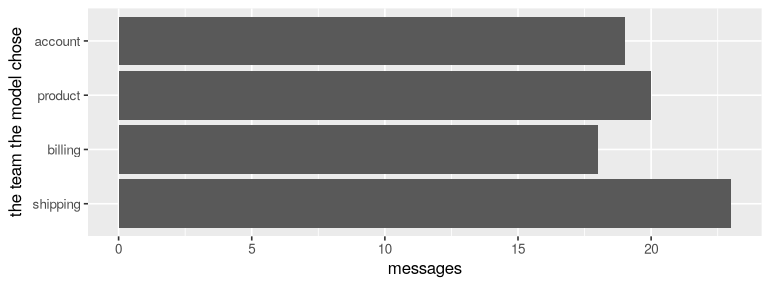
That was eighty model calls. functai sends up to eight at a time, so it took seconds, not minutes. The result is an ordinary tibble, and guess is an ordinary factor, so everything you know from dplyr and ggplot2 works on it:
#| fig-height: 2.6
answered |>
  count(guess) |>
  ggplot(aes(n, guess)) +
  geom_col() +
  labs(x = "messages", y = "the team the model chose")
Was it right?
We have a person's answer (category) next to the model's (guess), so "how often is it right?" is a proportion, one line of dplyr:
answered |>
  summarise(right = sum(guess == category), n = n(), accuracy = mean(guess == category))
# A tibble: 1 × 3
  right     n accuracy
  <int> <int>    <dbl>
1    76    80     0.95
A good score for a function you wrote in three lines. But the interesting rows are the wrong ones:
answered |>
  filter(guess != category) |>
  select(category, guess, message)
# A tibble: 4 × 3
  category guess    message
  <chr>    <fct>    <chr>
1 billing  product  I want a refund for the chair, it wobbles no matter what I …
2 billing  shipping Why was I charged for shipping when my order was over $50?
3 billing  product  The duvet shrank in the wash, I'd like my money back.
4 billing  account  How do I stop my saved card from being used for future orde…
Read them next to the shop's house rules (they're in ?tickets). Two rules trip up anyone who hasn't read them:
- anything that arrived broken is shipping, because the carrier pays;
- every request for money back is billing, whatever the reason.
Here, every miss is about money: a refund asked for because a product is poor looks like a product problem, a shipping charge sounds like shipping, a saved card sounds like an account setting. A new colleague would make the same sensible guesses, and they wouldn't be the shop's. The model doesn't know the rules either.
Tell it what you know
The sentence you give ai() is the function's code. The most direct fix is to write the rules into it:
team_rules <- ai(team ~ message,
  "Which team should answer this customer message?
  House rules:
  - Anything wrong with the delivery itself (late, lost, wrong address, wrong item,
    something missing, or broken when it arrived) is shipping: the carrier pays.
  - Anything about money (charges, invoices, coupons, cards, and every request for
    money back, whatever the reason) is billing.
  - Problems that appear while using a product, and questions about products, are product.
  - Signing in, passwords, profile details, personal data and emails from the shop are account.",
  team = choice("shipping", "billing", "product", "account"))

answered <- answered |>
  mutate(guess_rules = team_rules(message))

answered |>
  summarise(without_rules = mean(guess == category), with_rules = mean(guess_rules == category))
# A tibble: 1 × 2
  without_rules with_rules
          <dbl>      <dbl>
1          0.95          1
The rules came from the shop's policy, not from peeking at the wrong answers, and they helped. One honest caveat: we measured both versions on the same eighty messages we've been staring at. That flatters any change you make. Tutorial 4 shows how to test a change fairly, and tutorial 3 how sure you can be of a score from eighty rows.
The same function, another model
Nothing in team_rules is specific to OpenAI. update() makes a copy with other settings, such as another provider's model. Here is a message that sits exactly where two rules meet, asked of both:
vase <- "The vase came in pieces, can I get my money back?"
team_claude <- update(team_rules, lm = "claude-haiku-4-5")

c(gpt_6_luna = team_rules(vase), claude_haiku = team_claude(vase))
  gpt_6_luna claude_haiku
     billing     shipping
Levels: shipping billing product account
(The second call needs an ANTHROPIC_API_KEY. Skip it if you don't have one: nothing below depends on it.)
Broken on arrival says shipping; a request for money back says billing. The shop's answer is billing, because the money rule says "whatever the reason". Two models reading the same rules can land on different sides, because the description never says which rule wins when both apply. That's the most useful thing to learn here: where two rules meet is exactly where a model hesitates. The fix is more words ("if a message asks for money back, it is billing, even when the item arrived broken"), then checking again, on messages you didn't write the rule from.
What it cost
Every call went into the log folder. calls() reads it back as a tibble, one row per call:
log <- calls(folder = log_folder)
log |> select(name, model, seconds, input_tokens, output_tokens, total_tokens)
# A tibble: 163 × 6
   name  model      seconds input_tokens output_tokens total_tokens
   <chr> <chr>        <dbl>        <dbl>         <dbl>        <dbl>
 1 team  gpt-6-luna    1.27           63            25           88
 2 team  gpt-6-luna    1.17           68            26           94
 3 team  gpt-6-luna    1.55           57            47          104
 4 team  gpt-6-luna    1.36           66            26           92
 5 team  gpt-6-luna    1.33           61            25           86
 6 team  gpt-6-luna    1.17           64            30           94
 7 team  gpt-6-luna    1.98           64           111          175
 8 team  gpt-6-luna    1.10           62            25           87
 9 team  gpt-6-luna    1.07           62            26           88
10 team  gpt-6-luna    1.34           67            38          105
# ℹ 153 more rows
Providers charge by the token, a piece of a word (about three quarters of an English word on average), with one price for what you send and a higher one for what the model writes. What it writes includes its hidden reasoning: recent models think before they answer, and you pay for the thinking. That's why we count total_tokens - input_tokens as the output.
Prices change, so write them down with the date you read them:
prices <- tribble(
  ~model,             ~input, ~output,   # dollars per million tokens, 2026-09-27
  "gpt-6-luna",         0.10,    0.50,
  "claude-haiku-4-5",   1.00,    5.00
)

log |>
  left_join(prices, by = "model") |>
  summarise(calls = n(),
            dollars = sum(input_tokens * input + (total_tokens - input_tokens) * output) / 1e6)
# A tibble: 1 × 2
  calls dollars
  <int>   <dbl>
1   163 0.00495
Keep that in mind when someone says language models are expensive. For sorting short messages, the small ones cost about as much as the electricity to read this page.
Your turn
- Write
urgent, a function that answersTRUEorFALSE: does this message need an answer today? (urgent = logical().) Run it onticketsandcount()the answers bycategory. Which team gets the most urgent messages? - Look at
ai_render(team_rules, message = "hi"). Where did your house rules go? - Give
team_rulesa message you write yourself that sits between two rules. What does it answer? Would a new colleague agree?
What you learned
ai(output ~ inputs, "what it does", output = type)writes a function whose body is a language model. It reads like a model formula, and it is vectorised, so it works inmutate()like any other function.- The answer comes back as the type you declared. A
choice()means the model can only give one of your answers, and you get a factor. ai_render()shows exactly what the model will read.- "Is it right?" is a proportion when you have the right answers in a column.
- The description is your function's code. Writing down what you know (the house rules) is the most direct way to make it better.
calls()reads the log: calls, time and tokens, and so dollars.
Next: 2. Answers you can compute with turns free-text field notes into a table of numbers, categories and records you can plot.
1. Your first AI function
Eighty customer messages, four teams, and a function whose body is a language model. By the end you will have sorted every message, counted how many it got right, made it better, and know what it cost to the cent.
A small homeware shop gets messages all day: a parcel that never came, a card charged twice, a kettle that won't boil, a password that won't work. Someone reads each one and forwards it to the team that can help: shipping, billing, product or account. Reading eighty messages is a morning. Reading eighty thousand is a job nobody wants.
You are going to write the function that does the reading, and use it like any other R function. This is where we are going:
tickets |>
  mutate(team = team(message)) |>
  count(team)
A column of text goes in; a column of teams comes out, as a factor, one model call per row. Everything else in this tutorial is about trusting that column.
What you need
- R 4.1 or later, and the packages below. functai, and the two packages it uses to talk to models (lmcc and lm15), install from GitHub:
install.packages(c("remotes", "dplyr", "ggplot2"))
remotes::install_github("MaximeRivest/lmcc", subdir = "r")
remotes::install_github("lm15-dev/lm15-r")
remotes::install_github("MaximeRivest/functai", subdir = "r")
- A key for a model provider. This series mostly uses OpenAI's. Put it in your
~/.Renvironfile (usethis::edit_r_environ()opens it), then restart R:
OPENAI_API_KEY=sk-...
- Less than a cent of model calls. You will see the exact bill at the end.
Setting up
library(functai)
library(dplyr)
library(ggplot2)

log_folder <- tempfile("functai-calls-")
ai_config(lm = "gpt-6-luna", log_calls = log_folder)
ai_config() sets choices for the whole session:
lmis the language model that will do the work.gpt-6-lunais OpenAI's smallest current model (September 2026): fast, and cheap enough that a thousand messages cost a few cents.log_callskeeps a record of every call in a folder. We will read it at the end to count what we spent. (tempfile()makes a fresh, empty folder name, so this tutorial only counts its own calls.)
The messages
functai comes with the shop's messages as a dataset, tickets. A person has already decided which team should answer each one: that's the category column. We won't show it to the model; it's the answer key.
tickets
# A tibble: 80 × 5
      id message                                       channel category order_id
   <int> <chr>                                         <chr>   <chr>    <chr>
 1     1 Hi, my order A-1042 still hasn't arrived and… email   shipping A-1042
 2     2 The mug arrived in pieces.                    chat    shipping <NA>
 3     3 I was charged twice for order B-2210, please… email   billing  B-2210
 4     4 How do I change the email on my account?      chat    account  <NA>
 5     5 The kettle lid doesn't close properly anymor… email   product  <NA>
 6     6 I'd like my money back for the toaster, it b… email   billing  <NA>
 7     7 Tracking for C-3319 hasn't moved since Monda… chat    shipping C-3319
 8     8 I forgot my password and the reset email nev… chat    account  <NA>
 9     9 Box was crushed and the lamp inside is crack… email   shipping D-4001
10    10 My coupon code SPRING10 didn't apply at chec… chat    billing  <NA>
# ℹ 70 more rows
count(tickets, category)
# A tibble: 4 × 2
  category     n
  <chr>    <int>
1 account     18
2 billing     22
3 product     18
4 shipping    22
A function with no body
Here is the function:
team <- ai(team ~ message, "Which team should answer this customer message?",
  team = choice("shipping", "billing", "product", "account"))
Read it the way you read a model formula:
team ~ messageis team, from the message, aslm(weight ~ height)is weight from height. What comes out goes on the left, what goes in on the right. The function is named after what it gives,team, and takes one argument,message.- The sentence says what it does, the way you'd explain the job to a new colleague.
team = choice(...)says what kind of answer comes back: one of these four teams, as a factor with these levels. The model may only answer one of them. An input you say nothing about, likemessage, is text.
There is no body for you to write. Printing the function shows what you declared, and which model will do the work:
team
<ai function> team ~ message
  Which team should answer this customer message?
  message  text
  team     one of shipping, billing, product, account
  model: gpt-6-luna
Every R function has three parts: its arguments, its body and its environment. team is no exception:
formals(team)
body(team)
$message

call_ai(.core, mget(.inputs, envir = environment()))
The body is one line: hand the inputs to a model. That's the whole idea. You write the arguments, the type of the answer and a sentence; a language model does the rest, every time the function is called.
What the model reads
A language model reads text and writes text. So what text does team send? ai_render() shows the exact request, without sending it (and without paying for it):
request <- ai_render(team, message = "My card was charged twice for order B-2210.")
cat(request$system)
cat(request$messages[[1]]$parts[[1]]$text)
Function: team

Which team should answer this customer message?

Reply in exactly this form:
<result>
one of: shipping, billing, product, account
</result>
<message>
My card was charged twice for order B-2210.
</message>
The first part is the instruction, written from your function: its name, your sentence, and the form the reply must take. The second part is the message itself. When the reply comes back, functai reads the text between <result> and </result>, checks it is one of the four levels, and hands you a factor. A reply that doesn't fit is asked again once; if it still doesn't fit, you get an error or an NA, never a made-up value.
One call
team("My card was charged twice for order B-2210.")
[1] billing
Levels: shipping billing product account
That took a second or two: the question went to OpenAI's servers, the model thought about it, and the answer came back as a factor with your levels.
A whole column
team is vectorised, like toupper() or nchar(): give it a vector of eighty messages and you get eighty answers back, in order. So it goes straight into mutate():
answered <- tickets |>
  mutate(guess = team(message))

answered |>
  select(category, guess, message)
# A tibble: 80 × 3
   category guess    message
   <chr>    <fct>    <chr>
 1 shipping shipping Hi, my order A-1042 still hasn't arrived and it's been thr…
 2 shipping shipping The mug arrived in pieces.
 3 billing  billing  I was charged twice for order B-2210, please fix this.
 4 account  account  How do I change the email on my account?
 5 product  product  The kettle lid doesn't close properly anymore after a mont…
 6 billing  billing  I'd like my money back for the toaster, it burns everythin…
 7 shipping shipping Tracking for C-3319 hasn't moved since Monday.
 8 account  account  I forgot my password and the reset email never comes.
 9 shipping shipping Box was crushed and the lamp inside is cracked. Order D-40…
10 billing  billing  My coupon code SPRING10 didn't apply at checkout.
# ℹ 70 more rows
That was eighty model calls. functai sends up to eight at a time, so it took seconds, not minutes. The result is an ordinary tibble, and guess is an ordinary factor, so everything you know from dplyr and ggplot2 works on it:
#| fig-height: 2.6
answered |>
  count(guess) |>
  ggplot(aes(n, guess)) +
  geom_col() +
  labs(x = "messages", y = "the team the model chose")
Was it right?
We have a person's answer (category) next to the model's (guess), so "how often is it right?" is a proportion, one line of dplyr:
answered |>
  summarise(right = sum(guess == category), n = n(), accuracy = mean(guess == category))
# A tibble: 1 × 3
  right     n accuracy
  <int> <int>    <dbl>
1    76    80     0.95
A good score for a function you wrote in three lines. But the interesting rows are the wrong ones:
answered |>
  filter(guess != category) |>
  select(category, guess, message)
# A tibble: 4 × 3
  category guess    message
  <chr>    <fct>    <chr>
1 billing  product  I want a refund for the chair, it wobbles no matter what I …
2 billing  shipping Why was I charged for shipping when my order was over $50?
3 billing  product  The duvet shrank in the wash, I'd like my money back.
4 billing  account  How do I stop my saved card from being used for future orde…
Read them next to the shop's house rules (they're in ?tickets). Two rules trip up anyone who hasn't read them:
- anything that arrived broken is shipping, because the carrier pays;
- every request for money back is billing, whatever the reason.
Here, every miss is about money: a refund asked for because a product is poor looks like a product problem, a shipping charge sounds like shipping, a saved card sounds like an account setting. A new colleague would make the same sensible guesses, and they wouldn't be the shop's. The model doesn't know the rules either.
Tell it what you know
The sentence you give ai() is the function's code. The most direct fix is to write the rules into it:
team_rules <- ai(team ~ message,
  "Which team should answer this customer message?
  House rules:
  - Anything wrong with the delivery itself (late, lost, wrong address, wrong item,
    something missing, or broken when it arrived) is shipping: the carrier pays.
  - Anything about money (charges, invoices, coupons, cards, and every request for
    money back, whatever the reason) is billing.
  - Problems that appear while using a product, and questions about products, are product.
  - Signing in, passwords, profile details, personal data and emails from the shop are account.",
  team = choice("shipping", "billing", "product", "account"))

answered <- answered |>
  mutate(guess_rules = team_rules(message))

answered |>
  summarise(without_rules = mean(guess == category), with_rules = mean(guess_rules == category))
# A tibble: 1 × 2
  without_rules with_rules
          <dbl>      <dbl>
1          0.95          1
The rules came from the shop's policy, not from peeking at the wrong answers, and they helped. One honest caveat: we measured both versions on the same eighty messages we've been staring at. That flatters any change you make. Tutorial 4 shows how to test a change fairly, and tutorial 3 how sure you can be of a score from eighty rows.
The same function, another model
Nothing in team_rules is specific to OpenAI. update() makes a copy with other settings, such as another provider's model. Here is a message that sits exactly where two rules meet, asked of both:
vase <- "The vase came in pieces, can I get my money back?"
team_claude <- update(team_rules, lm = "claude-haiku-4-5")

c(gpt_6_luna = team_rules(vase), claude_haiku = team_claude(vase))
  gpt_6_luna claude_haiku
     billing     shipping
Levels: shipping billing product account
(The second call needs an ANTHROPIC_API_KEY. Skip it if you don't have one: nothing below depends on it.)
Broken on arrival says shipping; a request for money back says billing. The shop's answer is billing, because the money rule says "whatever the reason". Two models reading the same rules can land on different sides, because the description never says which rule wins when both apply. That's the most useful thing to learn here: where two rules meet is exactly where a model hesitates. The fix is more words ("if a message asks for money back, it is billing, even when the item arrived broken"), then checking again, on messages you didn't write the rule from.
What it cost
Every call went into the log folder. calls() reads it back as a tibble, one row per call:
log <- calls(folder = log_folder)
log |> select(name, model, seconds, input_tokens, output_tokens, total_tokens)
# A tibble: 163 × 6
   name  model      seconds input_tokens output_tokens total_tokens
   <chr> <chr>        <dbl>        <dbl>         <dbl>        <dbl>
 1 team  gpt-6-luna    1.27           63            25           88
 2 team  gpt-6-luna    1.17           68            26           94
 3 team  gpt-6-luna    1.55           57            47          104
 4 team  gpt-6-luna    1.36           66            26           92
 5 team  gpt-6-luna    1.33           61            25           86
 6 team  gpt-6-luna    1.17           64            30           94
 7 team  gpt-6-luna    1.98           64           111          175
 8 team  gpt-6-luna    1.10           62            25           87
 9 team  gpt-6-luna    1.07           62            26           88
10 team  gpt-6-luna    1.34           67            38          105
# ℹ 153 more rows
Providers charge by the token, a piece of a word (about three quarters of an English word on average), with one price for what you send and a higher one for what the model writes. What it writes includes its hidden reasoning: recent models think before they answer, and you pay for the thinking. That's why we count total_tokens - input_tokens as the output.
Prices change, so write them down with the date you read them:
prices <- tribble(
  ~model,             ~input, ~output,   # dollars per million tokens, 2026-09-27
  "gpt-6-luna",         0.10,    0.50,
  "claude-haiku-4-5",   1.00,    5.00
)

log |>
  left_join(prices, by = "model") |>
  summarise(calls = n(),
            dollars = sum(input_tokens * input + (total_tokens - input_tokens) * output) / 1e6)
# A tibble: 1 × 2
  calls dollars
  <int>   <dbl>
1   163 0.00495
Keep that in mind when someone says language models are expensive. For sorting short messages, the small ones cost about as much as the electricity to read this page.
Your turn
- Write
urgent, a function that answersTRUEorFALSE: does this message need an answer today? (urgent = logical().) Run it onticketsandcount()the answers bycategory. Which team gets the most urgent messages? - Look at
ai_render(team_rules, message = "hi"). Where did your house rules go? - Give
team_rulesa message you write yourself that sits between two rules. What does it answer? Would a new colleague agree?
What you learned
ai(output ~ inputs, "what it does", output = type)writes a function whose body is a language model. It reads like a model formula, and it is vectorised, so it works inmutate()like any other function.- The answer comes back as the type you declared. A
choice()means the model can only give one of your answers, and you get a factor. ai_render()shows exactly what the model will read.- "Is it right?" is a proportion when you have the right answers in a column.
- The description is your function's code. Writing down what you know (the house rules) is the most direct way to make it better.
calls()reads the log: calls, time and tokens, and so dollars.
Next: 2. Answers you can compute with turns free-text field notes into a table of numbers, categories and records you can plot.